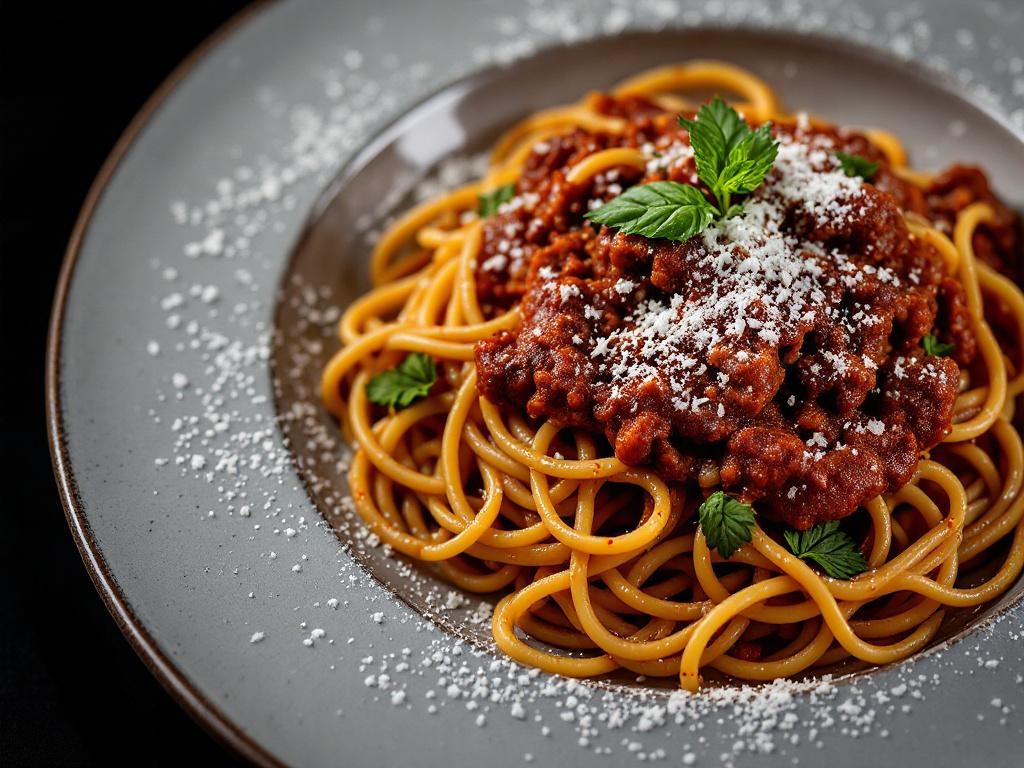
Spaghetti Bolognese
Bologna, Emilia-Romagna. The recipe was registered with the Bologna Chamber of Commerce in 1982, codifying the traditional preparation. Emilia-Romagna is Italy's richest food region — Parmigiano-Reggiano, prosciutto di Parma, mortadella, and ragu Bolognese all originate here.
The authentic Bolognese is not a tomato sauce with meat. It is a meat sauce with tomato — the distinction is everything. Soffritto built with patience, three meats (beef, pork, pancetta), milk added before wine to tenderise the proteins, and a minimum four-hour simmer. The result coats tagliatelle as a unified, yielding mass, not a pool of liquid.
Sangiovese is the only call — specifically Chianti Classico or Barbera d'Asti for a lighter hand. The bright cherry acidity of Sangiovese cuts the fat of the ragu and echoes the San Marzano tomato. Parmigiano-Reggiano grated at the table in visible shards.
{"Soffritto first: equal weight onion, carrot, and celery, cooked in butter over medium-low heat for 20 minutes until completely soft and sweet — not browned, never caramelised","Three-meat blend: 60% coarse-ground beef chuck or short rib, 30% coarse-ground pork shoulder, 10% finely diced pancetta — different fat profiles create layered complexity","Milk before wine: add 200ml whole milk to the browned meat, simmer until fully absorbed before adding white wine — the milk proteins protect the meat from acid, producing a more tender final texture","Minimal tomato: one tablespoon tomato paste and 400g San Marzano DOP, strained — this is a condiment, not the base. The ragu should be blonde-amber in colour, not red","Time is the ingredient: minimum four hours at a bare simmer, lid partially on, stirring every 30 minutes. Six hours produces a better result","Tagliatelle only: the ICA registered the authorised shape in 1972 — tagliatelle at 8mm width when cooked. Spaghetti is geographically and texturally incorrect for ragu Bolognese"}
RECIPE: Serves: 4 | Prep: 15 min | Total: 45 min --- 300 g ground beef (80/20 blend) 100 g ground pork 150 g soffritto (100 g onion, 30 g carrot, 20 g celery), minced 150 g whole milk 100 ml dry white wine 400 g San Marzano DOP tomatoes, crushed by hand 2 tbsp tomato paste 60 ml extra virgin olive oil 2 g sea salt 1 g Tellicherry black pepper --- 1. Heat olive oil in a heavy-bottomed pot over medium; add soffritto and sauté until translucent (4 minutes). 2. Add ground beef and pork, breaking apart with a wooden spoon; cook until no pink remains and fat renders (6 minutes). 3. Deglaze with white wine, scraping fond; simmer until liquid reduces by half (3 minutes). 4. Stir in tomato paste and cook for 1 minute, then add crushed tomatoes and simmer gently for 20 minutes. 5. Pour in milk and stir to combine; continue simmering for 10 minutes until sauce thickens slightly. 6. Season with sea salt and black pepper; taste and adjust. Finish with 1 tbsp olive oil for glossy sheen. The moment where Bolognese lives or dies is the mantecatura — the final emulsification of ragu and pasta in the pan. Drain tagliatelle 90 seconds before al dente. Add to the ragu pan with a ladleful of pasta water and a knob of cold butter. Toss vigorously over low heat until the pasta and sauce become one unified mass and a light, creamy foam forms. This takes 2 minutes. Without this step, the ragu sits on top of the pasta rather than coating it from within.
{"Using lean mince: the fat in chuck and pork shoulder renders into the sauce and becomes its backbone — lean mince produces a dry, grainy ragu","Rushing the simmer: under two hours, collagen has not converted to gelatin — the sauce lacks body and the meat tastes steamed rather than braised","Heavy on tomato: a red tomato sauce with meat in it is not Bolognese. The tradition is pale, meat-forward, yielding","Adding garlic to the soffritto: authentic Bolognese does not include garlic — onion, carrot, celery only"}
- French boeuf bourguignon (same technique: depth through long braising of beef in liquid); Taiwanese beef noodle soup braising (collagen extraction over hours); Moroccan slow-cooked kefta tagine (spiced ground meat cooked slowly in liquid — different profile, identical structural approach).
Common Questions
Why does Spaghetti Bolognese taste the way it does?
Sangiovese is the only call — specifically Chianti Classico or Barbera d'Asti for a lighter hand. The bright cherry acidity of Sangiovese cuts the fat of the ragu and echoes the San Marzano tomato. Parmigiano-Reggiano grated at the table in visible shards.
What are common mistakes when making Spaghetti Bolognese?
{"Using lean mince: the fat in chuck and pork shoulder renders into the sauce and becomes its backbone — lean mince produces a dry, grainy ragu","Rushing the simmer: under two hours, collagen has not converted to gelatin — the sauce lacks body and the meat tastes steamed rather than braised","Heavy on tomato: a red tomato sauce with meat in it is not Bolognese. The tradition is pale, meat-forward,
What dishes are similar to Spaghetti Bolognese?
French boeuf bourguignon (same technique: depth through long braising of beef in liquid); Taiwanese beef noodle soup braising (collagen extraction over hours); Moroccan slow-cooked kefta tagine (spiced ground meat cooked slowly in liquid — different profile, identical structural approach).